
العربية
لمحة عامة عن الأجيال، انظر فولكس واجن غولف. فولكس واجن جولف MK2 هي سيارة مدمجة، والجيل الثاني من سيارة فولكس واجن غولف وخلفا لفولكس واجن جولف MK1. وكان حجم البائع فولكس واجن من عام 1983 وبقي في (الألمانية) الإنتاج حتى أواخر عام 1992. وكان MK2 أكبر من MK1. قاعدة عجلاتها نمت قليلا (+ 75 ملم (3.0 في))، كما فعل الأبعاد الخارجية (الطول + 180 ملم (7.1 في) والعرض + 55 ملم (2.2 في)، الطول + 5 ملم (0.2 في)). كان وزن يصل وفقا لذلك بنحو 120 كلغ (260 £). التصميم الخارجي، وضعت في المنزل من قبل مدير التصميم VW شيفر، أبقى الخطوط العامة للسابقتها جيوجيارو تصميم، ولكن كان قليلا أكثر تنوعا. وقال كل شيء، عن 6.3 مليون [2] بنيت الركبة من الجيل الثاني.
1 جولف مارك 2 2 نماذج 2.1 غولف GTI & GTI 16V 2.2 جولف Syncro 2.3 رالي جولف 2.4 جولف G60 المحدودة 2.5 جولف البلد 2.6 جولف MK2 citySTROMer 3 محركات 4 أمريكا الشمالية 5 المكسيك (1987-1992) 6 اليابان 7 المملكة المتحدة 8 المراجع 9 وصلات خارجية لعبة غولف مارك 2 5door فولكس فاجن جولف MK2 الخلفي تم إطلاق الجيل الثاني من فولكس واجن غولف (المعروف أيضا باسم الطباع 19E حتى نموذج عام 1991، والطباع 1G بعد ذلك) في أوروبا في معرض فرانكفورت للسيارات في سبتمبر 1983، مع مبيعات تبدأ في وطنه ومعظم محرك أقراص آخر الأيسر الأسواق بعد فترة وجيزة. ذلك لاول مرة مارس 1984 في السوق البريطاني، وكان عرضه كنموذج عام 1985 في الولايات المتحدة. انها ظهرت وهيكل السيارة وأكبر، ومجموعة واسعة من خيارات المحرك، بما في ذلك توربوديسيل GTD (في الأسواق الأوروبية، في وقت لاحق باستخدام "UMWELT" 1.6 (ECO) محرك الديزل)، وسم مكعب DOHC 1781 (1.8) إصدار 16-صمام لل مستقيم أربعة GTI (فضلا عن تجربتها واختبارها 1781cc (1.8) 8V GTI)، و8V السوبر "G60" مع خيارات محرك المواجهه والرباعي، وسباق أقرته البديل من هذا، فإن "رالي جولف". كان من المفترض هذا النموذج أن يأتي إلى الولايات المتحدة وكذلك (أشر باسم "رالي GTI")، وقدمت نماذج، لكنه لم يأت ليكون. وكان جولف الأصلي كان واحدا من عدد قليل من هاتشباك بالدفع على العجلات الأمامية للبيع عندما أطلقت في عام 1974، ولكن في غضون عقد من الزمن تقريبا جميع الشركات المصنعة الكبرى قد شنت تشبه لعبة غولف هاتشباك الأسرة. وكان فورد قد تحولت إلى العجلات الأمامية بالسيارة شكل هاتشباك للMK3 مرافقة في عام 1980، بعد وقت قصير جنرال موتورز قد تكيفت هذا المفهوم لآخر من أوبل كاديت (فوكسهول أسترا في بريطانيا). لم أوستن روفر (سابقا البريطانية ليلاند) لا تدخل السوق الصغيرة هاتشباك الأسرة حتى إطلاق مايسترو لها في بداية عام 1983، على الرغم من أنها قد أطلقت أكبر ماكسي هاتشباك لها منذ فترة طويلة في عام 1969، وعام 1976 اتخذت خطوة غير عادية ثم ل إطلاق هيكل السيارة الهاتشباك على سيارة فاخرة (لاند روفر SD1). سوف بيجو لا إطلاق أول لعبة غولف الحجم هاتشباك لها (309) حتى أواخر عام 1985، لكنها اتخذت ملكية تقسيم كرايسلر الأوروبي في عام 1978، بعد إطلاق هاتشباك كرايسلر / سيمكا الأفق. بيد أن أمثال فيات ورينو وفولفو دخل كل سوق صغيرة هاتشباك الأسرة بحلول نهاية من 1970s. قد يصبح هيكل السيارة الهاتشباك أيضا شعبية على السيارات المنتجة خارج أوروبا، وخاصة على الموديلات اليابانية. في عام 1985، مجلة السيارات البريطانية ما السيارة؟ جائزة "سيارة العام" جولف MK2 1985 م. انها تباع بشكل جيد في بريطانيا، وتبلغ ذروتها في عام 1989 مع أكثر من 50،000 المبيعات كما 11th أفضل سيارة مبيعا والسيارات الأجنبية الأكثر شعبية. ومع ذلك، فقد طغت على لعبة غولف في عام 1984 الأوروبية السيارات من المسابقة السنة، المركز الثالث ولكن يجري تقدمن بشكل كبير من قبل منتصرا فيات أونو والوصيفة بيجو 205، والتي كانت مشابهة في حجمها أصغر بولو فولكس واجن. [3] خلال حياة جولف MK2، كان هناك عدد من التنقيحات نمط خارجية. وشملت التغييرات البارزة ليبدو من لعبة غولف MK2 إزالة النوافذ quarterlight في الأبواب الأمامية، وإدخال الشرائح مصبغة أكبر مع عمليات تجميل أغسطس 1987. كان أبرزها إدخال ما يسمى ب "مصدات الكبير"، والتي أدخلت في السوق الأوروبية مع أغسطس 1989 عمليات تجميل. كانت متاحة في الولايات المتحدة في أغسطس 1989، أيضا، كجزء من حزمة "فولفسبورغ طبعه". أنها لم تكن موحدة حتى كانون الثاني، 1990. تم تسويقه هذا جولف للمرة الأولى بهذا الاسم في الولايات المتحدة وكندا. إن الهدف من الاسم الأرنب المستخدمة في MK1 لإعطاء السيارة صورة محبوب، ولكن مع إعادة تصميم 1980s من السيارة، كارل هان، فولكس واجن السابق لرئيس أمريكا الذي كان الآن رئيس مجلس إدارة الشركة بأكملها، وأملى أن أسماء نموذج فولكس واجن تكون موحدة على الصعيد العالمي. جيمس فولر، رئيس علامة فولكس واجن في أمريكا الشمالية، واتفق في استخدام اسم جولف التأكيد على الطابع السيارة توتوني. أصبحت طقم الجسم GTI المتاحة على عدم حقن جولف وبيعت باسم "سائق" خفض مستوى في أوروبا. في حين أن GTI بقي مستوى تقليم في لعبة غولف تشكيلة في أوروبا، في بعض الأسواق، كان (ولا يزال) تسويقه باعتباره خط نموذج منفصل. كما أنتجت فولكس واجن نموذجهم في يوغوسلافيا، في مصنع في فوغوسكا بالقرب من سراييفو، ودعا Tvornica Automobila سراييفو - TAS. تم إنتاج MK2 من عام 1985 مع الإنتاج السنوي من 25،000 وحدة حتى اندلاع الحرب في عام 1992. [بحاجة لمصدر] وقد أنتج هذا النموذج فقط لالجمهوريات اليوغوسلافية الست، مع شارة الخلفية JX (الذي يرمز للمعدات أقل من C و CL)، C وCL وTAS شارة على الشبك الأمامي وشعار مدينة سراييفو امض بدلا جانبية. وكانت محركات 1.3 (المكربن)، 1.6 البنزين والديزل 1.6. نماذج 1987-1989 فولكس واجن جولف II 5-باب (فرنسا) 1988-1989 فولكس واجن جولف 3-باب (US) كان جولف MK2 متوفر على شكل هاتشباك 3- و5-الباب. تم تسويقها 2-الباب و4-باب المتغيرات سيدان من لعبة غولف MK2 تحت اسم فولكس واجن جيتا. وقد وضعت لم إصدار حنطور من MK2. بدلا من ذلك، واصل تحويل مقرها MK1 إلى أن يتم إنتاجها، مع تغييرات طفيفة. وتضمنت خفض مستويات قاعدة، C، CL وGL والبداية قيراط نموذج يتوج المدى (حتى عام 1986)، في وقت لاحق GT (في عام 1987) كان الإصدار أيضا على العرض. في أمريكا الشمالية، لم يكن هناك سوى نموذج قاعدة حتى عام 1986، في عام 1987 نموذجا GL وGT، في الفترة 1988-1989، كان هناك كل ثلاثة، وفي عام 1990 وحتى نهاية شوطه كان هناك مرة أخرى فقط GL. وجدت نموذج GTI from 1985-1987، ومرة أخرى من 1990-1992، وكانت موجودة في 16V GTI 1987-1992. في اليابان تألف مجموعة من حفز نماذج تسى / CLI / GLI جميع تقاسم نفس 1.6 أو في وقت لاحق 1.8 لتر I4 محركات حقن الوقود. في سياق السنين، مجموعة من "طبعة محدودة" نماذج ظهرت في الأسواق المختلفة، وتتميز تغييرات تجميلية و / أو قائمة ميزات المخصب. عموما، كانت هذه الحزم الخيار على رأس قاعدة "نموذج" (CL، GL، وما إلى ذلك). أيضا في بعض البلدان أنه يمكن العثور على خفض مستوى TX (النمسا) وJX (يوغوسلافيا) كان المحرك الأساس الجديد 1.05 لتر يتمشى الأربعة؛ وتضمنت العروض المحرك الأخرى 1.3، 1.6 و 1.8 أربع لتر البنزين و 1.6 لتر من الطبيعي أن يستنشق أو محركات الديزل توربو. في أمريكا الشمالية، وكان كل لعبة غولف Mk2s 1.8 لتر البنزين أو 1.6 محركات الديزل (وGTI، في حين لم تكن نموذجا للغولف في أمريكا الشمالية كان، أيضا نموذج 2.0 لتر). جولف GTI وGTI 16V فولكس واجن GTI 1990-1992 3-باب (US) 1988 م: جولف 16V وقد واصلت الناجح جولف GTI (أو، في الولايات المتحدة الأمريكية، وذلك ببساطة "GTI") مع MK2 كما رياضي 3- أو 5 أبواب هاتشباك. مثل الراحل MK1 GTIs، فإنه تضمن حقن الوقود 1.8 لتر أربع تطوير 112 PS (82 كيلوواط، 110 حصان). في 1986 (1987 في أمريكا الشمالية) وقدم لعبة غولف GTI 16V. هنا وضع محرك 1.8 لتر من 139 PS (102 كيلوواط، 137 حصان) (أو 129 PS (95 كيلوواط، 127 حصان) للحصول على الإصدار حافزا) وكان الاحتفال النموذج من قبل سرية الأحمر والأسود "16V" شارات الأمامية والخلفية. وتم تزويد الولايات المتحدة / GTIs الكندية في وقت لاحق مع 2.0 16 صمام محركات، المتاحة في باسات وكورادو خارج أمريكا الشمالية. في عام 1990، مثل لعبة غولف، أعطيت GTI عملية شد وجه، وأصبح "الوفير الكبير" قياسي على جميع GTIs. واستمر هذا من خلال ما تبقى من العصر نموذج MK2. في عام 1990 تم إدخال سيارة GTI G60 أيضا يضم 8V 1.8 مع شحان G60 هذا الإصدار لا ينبغي الخلط بينه وبين G60 المحدودة نادر جدا (انظر أدناه). جولف Syncro في فبراير عام 1986، قدمت فولكس واجن جولف الأول مع الدفع الرباعي. كان هذا جولف Syncro المتاحة مع محرك 1.8 فقط (90 PS (66 كيلوواط، 89 حصان)، في وقت لاحق 98 PS (72 كيلوواط، 97 حصان)). قد تم تطوير نظام 4WD لها بالتعاون مع شتاير دايملر-بوتش [4] من النمسا، وظهرت اقتران لزج والتقسيم مرن من عزم الدوران بين الأمام والمحور الخلفي. نظرا لارتفاع سعره (في عام 1986، كلف Syncro حوالي 30٪ أكثر من جبهة نموذج الدفع الرباعي يعادل [5]) ظل نموذج نادر. 1986-1989، على سبيل المثال، بنيت فقط 26،000 [6] Syncros. رالي جولف رالي جولف في عام 1989، ظهر رالي جولف باعتباره رالي "تجانس خاص". تمييزها بواسطة أقواس العجلات التي استمرت اندلع مربع (على غرار أودي كواترو، BMW E30 M3 وانسيا دلتا Integrale) والمصابيح الأمامية العرض مستطيلة، وهذا النموذج المميز Syncro الدفع الرباعي، تحول كابل نقل وG-شحان 1763 سم مكعب (أقل من نموذجي 1.8L 1781 سم مكعب لتلبية قواعد المحرك التشريد) نسخة من حقن 8 صمام المحرك 1.8 لتر G60. بنيت خمسة آلاف سيارة فولكس واجن في بروكسل، بلجيكا، والنبات، بسعر حوالي 50،000 DM كل (أو تقريبا ضعفي قاعدة جولف GTI). في رالي جولف ديه 161Bhp (118 كيلوواط). [7] أيا كانت تباع رسميا في الولايات المتحدة الأمريكية. تم إرسال اثنين على مدى رسميا للاختبار، مع خمسة المرسلة عبر للتقييم. كان فولكس فاجن الأمريكية نائب الرئيس جيمس فولر من مؤيدي بالإضافة إلى الولايات المتحدة / تشكيلة الكندية. ولكن كان فولر قتلوا في ديسمبر 1988 حين عودته من ألمانيا على متن طائرة بان آم رحلة 103، عندما انفجرت قنبلة زرعها الإرهابيون الليبي فوق لوكربي باسكتلندا. كان لهذا تأثير ضار على فرص رالي جولف للاستيراد إلى أمريكا الشمالية. في نهاية المطاف، قرر فولكس فاجن الأمريكية أن رالي جولف سيكون مكلفا للغاية لتقديم للبيع في الولايات المتحدة وكندا، حيث يعتقد مشتري السيارات من فولكس واجن كما بأسعار منخفضة العلامة التجارية. [8] جولف G60 المحدودة فولكس واجن جولف المحدودة وبناء على رالي لعبة غولف، وجود طبعة محدودة جدا جولف MK2 البديل، والجمع بين كل الخيارات خط رفيع (مقاعد جلدية مع مقاعد ساخنة والارتفاع أمام قابل للتعديل، 4 نوافذ كهربائية، مرايا كهربائية، وتقاسم المنافع، توجيه معزز، فتحة سقف الخ) متاحة في ذلك الوقت. صممت وبنيت يدويا من قبل قسم فولكس واجن موتورسبورت، أنتجت فقط 71 من "جولف G60 المحدودة" النماذج. [9] وشملت حزمة ميزة حصرية لG60 السوبر نسخة من محرك 16 صمام، تزاوج إلى انتقال الرياضية وSyncro بالعجلات الأربع آلية محرك الأقراص، جميع السيارات حيث بناء في خمسة أبواب بسبب قوة هيكل 5 باب (للمزيد من زوايا)، عجلات BBS RM012 في 6.5Jx15 "، مصدات الولايات المتحدة، مصبغة، المصباح اثنين عادي مع تفصيل الأزرق فريدة من نوعها، وVW موتورسبورت الشعار، والأسود VW الشعار، والمصابيح الخلفية هيلا ملون، وشارات رياضة السيارات ولوحة مرقمة خاصة. وفي عام 1989، كلفت هذه السيارات في منطقة DM 68،500 [7] كل وبيعت في المقام الأول إلى المديرين التنفيذيين VAG والإدارة. هذه السيارات أنتجت 210 PS (154 كيلوواط، 207 حصان) 252 N · م (186 £ · قدم) وتسارع من 0-100 كلم / ساعة (0-62 ميل في الساعة) في 7.2 ثانية، مما يجعلها أقوى فولكس فاجن جولف على الإطلاق حتى VW أصدرت R32 MK4 مع 241 PS (177 كيلوواط، 238 حصان) في عام 2003. جولف البلد فولكس واجن جولف البلد كان هناك أيضا نسخة دعا جولف البلد (3،000 سيارة)، والمصممة لضوء القيادة على الطرق الوعرة. وكان أكثر تعليق السفر، الدفع الرباعي، bullbars (عموما أكثر من الشبك الأمامي واحدة)، لوحة انزلاق لحماية منطقة المحرك، وعجلة احتياطية شنت خارجيا على ظهره. في أوروبا، وتم عرضها مع المشهود 114 حصانا (85 كيلوواط) محرك 1.8 8V البنزين. كانت هناك أيضا: 160 "البلد ALLROUND". 558 "البلد - Chrompaket" مع bullbars كروم والبيج جلد. و50 "البلد GTI" لVW-الموظفين. كان جولف البلد بشعبية خاصة في مناطق جبال الألب في وسط أوروبا. [بحاجة لمصدر] جولف MK2 citySTROMer في عام 1984 فولكس واجن، بالتعاون مع RWE، أصدرت الجيل الثاني "الذهب citySTROMer، وهو نسخة الكهربائي للMK2 جولف. وكان هذا اول الكهربائية فولكس واجن لدخول إنتاج المسلسل كما كان MK1 citySTROMER فقط سيارة النموذج الأولي. كان MK2 citySTROMer مجموعة من حوالي 31 ميل (50 كم) وتستخدم 16 بطاريات هلام بالكهرباء شنت تحت منطقة الشحن والمقاعد الخلفية. وأنتجت بعد 100 citySTROMers MK2 وبيعها ل45،000DM (~ الولايات المتحدة 34،000 $) حتى توقف الإنتاج في عام 1985. [10] واستمر اسم citySTROMer في نماذج لاحقة؛ جيتا citySTROMer وMK3 جولف citySTROMer. [11]
يوجد الكثير من الاخطاء الإملائية للاسف واتمني ان تتابعونا
english
The second-generation Volkswagen Golf (also known as the Typ 19E until the 1991 model year, and Typ 1G thereafter) was launched in Europe at the Frankfurt Motor Show in September 1983, with sales beginning in its homeland and most other left-hand drive markets soon after. It debuted in March 1984 on the British market, and it was introduced as a 1985 model in the US. It featured a larger bodyshell, and a wider range of engine options, including a GTD turbodiesel (in Euro markets, later using the 1.6 "umwelt" (ECO) diesel engine), a DOHC 1781 cc (1.8) 16-valve version of the straight-four GTI (as well as the tried and tested 1781cc (1.8) 8v GTI), the supercharged 8v "G60" with front- and four-wheel drive options, and a racing homologated variant of this, the "Rallye Golf". This model was meant to come to the US as well (badged as "Rallye GTI"), and prototypes were made, but it did not come to be.
The original Golf had been one of the few front-wheel drive hatchbacks on sale when launched in 1974, but within a decade almost all major manufacturers had launched a Golf-like family hatchback. Ford had switched to front-wheel drive hatchback format for its MK3 Escort in 1980, soon after General Motors had adapted that concept for its latest Opel Kadett (Vauxhall Astra in Britain). Austin Rover (formerly British Leyland) did not enter the small family hatchback market until the launch of its Maestro at the beginning of 1983, although it had launched its larger Maxi hatchback as long ago as 1969 and in 1976 had taken the then unusual step of launching a hatchback bodystyle on a luxury car (the Rover SD1). Peugeot would not launch its first Golf-sized hatchback (the 309) until late 1985, but it had taken ownership of Chrysler's European division in 1978, just after the launch of the Chrysler/Simca Horizon hatchback. However, the likes of Fiat, Renault and Volvo had all entered the small family hatchback market by the end of the 1970s. The hatchback bodystyle had also become popular on cars produced outside Europe, particularly on Japanese models.
In 1985, British motoring magazine What Car? awarded the Golf Mk2 1985 "Car of the Year". It sold well in Britain, peaking in 1989 with well over 50,000 sales as the 11th best selling car and most popular foreign car.
However, the Golf was overshadowed in the 1984 European Car of the Year contest, finishing third but being heavily outscored by the victorious Fiat Uno and runner-up Peugeot 205, which were similar in size to Volkswagen's smaller Polo.[3]
During the life of the Golf MK2, there were a number of external style revisions. Notable changes to the looks of the Golf MK2 included the removal of quarterlight windows in the front doors, and the introduction of larger grille slats with the August 1987 facelift. The most notable was the introduction of so-called "Big Bumpers", which were introduced in the European market with an August 1989 facelift. They were available in the US from August 1989 as well, as part of the "Wolfsburg Edition" package. They were not standardized until January, 1990.
This Golf was marketed for the first time with that name in the United States and Canada. The Rabbit name used on the Mk1 was meant to give a car a cuddly image, but with the 1980s redesign of the car, Carl Hahn, the former Volkswagen of America president who was now chairman of the whole company, dictated that Volkswagen model names be standardized globally. James Fuller, head of the Volkswagen brand in North America, concurred in using the Golf name to stress the car's Teutonic character. The GTI body kit became available on a non-injection Golf and was sold as the "Driver" trim level in Europe. While the GTI remained a trim level in the Golf lineup in Europe, in some markets, it was (and continues to be) marketed as a separate model line.
Volkswagen also produced their model in Yugoslavia, in a factory at Vogosca near Sarajevo, called Tvornica Automobila Sarajevo - TAS. The MK2 was produced from 1985 with a yearly production of 25,000 units until the outbreak of war in 1992.[citation needed] This model was produced only for the six Yugoslav republics, with a rear badge JX (which stands for less equipment than C and CL), C and CL and TAS badge on the front grille and Sarajevo city logo instead side blinkers. Engines were 1.3 (carburetor), 1.6 petrol and 1.6 diesel.

 The Golf Mk2 was available as a 3- and 5-door hatchback. The 2-door and 4-door sedan variants of the Golf Mk2 were marketed under the Volkswagen Jetta
name. No cabriolet version was developed from the Mk2; instead, the
Mk1-based convertible continued to be produced, with minor changes.
The Golf Mk2 was available as a 3- and 5-door hatchback. The 2-door and 4-door sedan variants of the Golf Mk2 were marketed under the Volkswagen Jetta
name. No cabriolet version was developed from the Mk2; instead, the
Mk1-based convertible continued to be produced, with minor changes.
Trim levels included base, C, CL and GL and initially a range-topping Carat model (until 1986), later a GT (in 1987) version was also on offer. In North America, there was only a base model until 1986, in 1987 a GL and GT model, in 1988-1989, there were all three, and in 1990 until the end of its run there was again only a GL. The GTI model existed from 1985–1987, and again from 1990–1992, and the GTI 16v existed from 1987–1992. In Japan the range consisted of catalysed Ci/CLi/GLi models all sharing the same 1.6 or later 1.8 liter fuel-injected I4 engines. In the course of the years, a host of "limited edition" models appeared on various markets, distinguished by cosmetic changes and/or an enriched features list. Generally, these were option packages on top of a base "model" (CL, GL, etc.). Also in some countries it could be found trim level TX (Austria) and JX (Yugoslavia)
New base engine was a 1.05 litre inline four; other engine offerings included 1.3, 1.6 and 1.8 litre petrol fours and 1.6 litre naturally aspirated or turbocharged diesel engines. In North America, all Golf Mk2s had 1.8 liter petrol or 1.6 diesel engines (the GTI, while not a Golf model in North America, also had a 2.0 liter model).

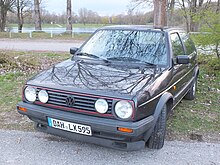 The successful Golf GTI (or, in the USA, simply "GTI") was continued with the Mk2 as a sporty 3- or 5-door hatchback.
Like late Mk1 GTIs, it featured a fuel-injected 1.8 litre four
developing 112 PS (82 kW; 110 hp). In 1986 (1987 for North America) a Golf GTI 16V
was introduced; here the 1.8 litre engine put out 139 PS (102 kW;
137 hp) (or 129 PS (95 kW; 127 hp) for the catalyst version) and the
model was marked by discreet red and black "16v" badges front and rear.
US/Canadian GTIs were later equipped with 2.0 16 valve-engines,
available in the Passat and Corrado outside North America. In 1990, like
the Golf, the GTI was given a facelift, and the "Big Bumper" became
standard on all GTIs. This was maintained through the rest of the Mk2
model era. In 1990 the GTi G60 was also introduced featuring the 8v 1.8
with a G60 supercharger this version is not to be confused with the very rare G60 Limited (see below).
The successful Golf GTI (or, in the USA, simply "GTI") was continued with the Mk2 as a sporty 3- or 5-door hatchback.
Like late Mk1 GTIs, it featured a fuel-injected 1.8 litre four
developing 112 PS (82 kW; 110 hp). In 1986 (1987 for North America) a Golf GTI 16V
was introduced; here the 1.8 litre engine put out 139 PS (102 kW;
137 hp) (or 129 PS (95 kW; 127 hp) for the catalyst version) and the
model was marked by discreet red and black "16v" badges front and rear.
US/Canadian GTIs were later equipped with 2.0 16 valve-engines,
available in the Passat and Corrado outside North America. In 1990, like
the Golf, the GTI was given a facelift, and the "Big Bumper" became
standard on all GTIs. This was maintained through the rest of the Mk2
model era. In 1990 the GTi G60 was also introduced featuring the 8v 1.8
with a G60 supercharger this version is not to be confused with the very rare G60 Limited (see below).
 In 1989, the Rallye Golf appeared as a rallye "homologation
special". Distinguishable by its box-flared wheel arches (similar to
the Audi quattro, BMW E30 M3 and Lancia Delta Integrale) and rectangular
projector headlamps, this model featured Syncro four-wheel drive, a
cable shifted transmission and a G-supercharger
1763 cc (less than the typical 1.8L 1781 cc to meet the engine
displacement rules) version of the injected 8 valve G60 1.8 liter
engine.
In 1989, the Rallye Golf appeared as a rallye "homologation
special". Distinguishable by its box-flared wheel arches (similar to
the Audi quattro, BMW E30 M3 and Lancia Delta Integrale) and rectangular
projector headlamps, this model featured Syncro four-wheel drive, a
cable shifted transmission and a G-supercharger
1763 cc (less than the typical 1.8L 1781 cc to meet the engine
displacement rules) version of the injected 8 valve G60 1.8 liter
engine.
Five thousand cars were built in Volkswagen's Brussels, Belgium, plant, priced at about DM 50,000 each (or roughly twice as much as a base Golf GTI). The Rallye Golf has 161Bhp (118 kW).[7]
None were officially sold in the USA. Two were sent over officially for testing, with five sent over for evaluation. Volkswagen of America vice-president James Fuller was a supporter of its addition to the U.S./Canadian lineup. But Fuller was killed in December 1988 while flying home from Germany aboard Pan Am Flight 103, when a bomb planted by Libyan terrorists exploded over Lockerbie, Scotland; this had a detrimental effect on the Rallye Golf's chances of importation to North America.
Eventually, Volkswagen of America decided that the Rallye Golf would be too expensive to offer for sale in the United States and Canada, where car buyers thought of Volkswagen as a low-priced brand.[8]
 Based on the Rallye Golf, a very limited edition Golf Mk2 variant
exists, combining all of the high-line options (Leather interior with
heated and height adjustable front seats,4 electric windows,electric
mirrors,abs,power steering,sunroof etc.) available at the time. Designed
and hand-built by the Volkswagen Motorsport division, only 71 of the
"Golf G60 Limited" models were produced.[9] The exclusive feature package included a G60 supercharged version of the 16-valve engine, mated to a sports transmission and Syncro four-wheel drive mechanism, all cars where build in five doors because of the strength of a 5 door chassis (more angles), BBS
RM012 wheels in 6.5Jx15", US bumpers, a plain two-headlight grille with
a unique blue detail,and a VW Motorsport logo, black VW logo, Hella tinted taillights, motorsport badges and a special numbered plaque. In 1989, these cars cost in the region of DM 68,500[7] each and were primarily sold to VAG
executives and management. These cars produced 210 PS (154 kW; 207 hp)
252 N·m (186 lb·ft) and accelerated from 0–100 km/h (0-62 mph) in 7.2
seconds, making them the most powerful VW Golf ever produced until VW
released the Mk4 R32 with 241 PS (177 kW; 238 hp) in 2003.
Based on the Rallye Golf, a very limited edition Golf Mk2 variant
exists, combining all of the high-line options (Leather interior with
heated and height adjustable front seats,4 electric windows,electric
mirrors,abs,power steering,sunroof etc.) available at the time. Designed
and hand-built by the Volkswagen Motorsport division, only 71 of the
"Golf G60 Limited" models were produced.[9] The exclusive feature package included a G60 supercharged version of the 16-valve engine, mated to a sports transmission and Syncro four-wheel drive mechanism, all cars where build in five doors because of the strength of a 5 door chassis (more angles), BBS
RM012 wheels in 6.5Jx15", US bumpers, a plain two-headlight grille with
a unique blue detail,and a VW Motorsport logo, black VW logo, Hella tinted taillights, motorsport badges and a special numbered plaque. In 1989, these cars cost in the region of DM 68,500[7] each and were primarily sold to VAG
executives and management. These cars produced 210 PS (154 kW; 207 hp)
252 N·m (186 lb·ft) and accelerated from 0–100 km/h (0-62 mph) in 7.2
seconds, making them the most powerful VW Golf ever produced until VW
released the Mk4 R32 with 241 PS (177 kW; 238 hp) in 2003.
 There was also a version called Golf Country (3,000 cars), designed for light off-road driving. It had more suspension travel, four-wheel drive, bullbars (generally over a single headlight grille), a skid plate for protecting the engine area, and a spare wheel mounted externally on the back.
In Europe, it was offered with the acclaimed 114 bhp (85 kW) 1.8 8v petrol engine. There were also: 160 "Country Allround"; 558 " Country - Chrompaket" with Chrome bullbars and beige leather interior; and 50 "Country GTI" for VW-staff. The Golf Country was particularly popular in Alpine regions in central Europe.[citation needed]
لمحة عامة عن الأجيال، انظر فولكس واجن غولف. فولكس واجن جولف MK2 هي سيارة مدمجة، والجيل الثاني من سيارة فولكس واجن غولف وخلفا لفولكس واجن جولف MK1. وكان حجم البائع فولكس واجن من عام 1983 وبقي في (الألمانية) الإنتاج حتى أواخر عام 1992. وكان MK2 أكبر من MK1. قاعدة عجلاتها نمت قليلا (+ 75 ملم (3.0 في))، كما فعل الأبعاد الخارجية (الطول + 180 ملم (7.1 في) والعرض + 55 ملم (2.2 في)، الطول + 5 ملم (0.2 في)). كان وزن يصل وفقا لذلك بنحو 120 كلغ (260 £). التصميم الخارجي، وضعت في المنزل من قبل مدير التصميم VW شيفر، أبقى الخطوط العامة للسابقتها جيوجيارو تصميم، ولكن كان قليلا أكثر تنوعا. وقال كل شيء، عن 6.3 مليون [2] بنيت الركبة من الجيل الثاني.
1 جولف مارك 2 2 نماذج 2.1 غولف GTI & GTI 16V 2.2 جولف Syncro 2.3 رالي جولف 2.4 جولف G60 المحدودة 2.5 جولف البلد 2.6 جولف MK2 citySTROMer 3 محركات 4 أمريكا الشمالية 5 المكسيك (1987-1992) 6 اليابان 7 المملكة المتحدة 8 المراجع 9 وصلات خارجية لعبة غولف مارك 2 5door فولكس فاجن جولف MK2 الخلفي تم إطلاق الجيل الثاني من فولكس واجن غولف (المعروف أيضا باسم الطباع 19E حتى نموذج عام 1991، والطباع 1G بعد ذلك) في أوروبا في معرض فرانكفورت للسيارات في سبتمبر 1983، مع مبيعات تبدأ في وطنه ومعظم محرك أقراص آخر الأيسر الأسواق بعد فترة وجيزة. ذلك لاول مرة مارس 1984 في السوق البريطاني، وكان عرضه كنموذج عام 1985 في الولايات المتحدة. انها ظهرت وهيكل السيارة وأكبر، ومجموعة واسعة من خيارات المحرك، بما في ذلك توربوديسيل GTD (في الأسواق الأوروبية، في وقت لاحق باستخدام "UMWELT" 1.6 (ECO) محرك الديزل)، وسم مكعب DOHC 1781 (1.8) إصدار 16-صمام لل مستقيم أربعة GTI (فضلا عن تجربتها واختبارها 1781cc (1.8) 8V GTI)، و8V السوبر "G60" مع خيارات محرك المواجهه والرباعي، وسباق أقرته البديل من هذا، فإن "رالي جولف". كان من المفترض هذا النموذج أن يأتي إلى الولايات المتحدة وكذلك (أشر باسم "رالي GTI")، وقدمت نماذج، لكنه لم يأت ليكون. وكان جولف الأصلي كان واحدا من عدد قليل من هاتشباك بالدفع على العجلات الأمامية للبيع عندما أطلقت في عام 1974، ولكن في غضون عقد من الزمن تقريبا جميع الشركات المصنعة الكبرى قد شنت تشبه لعبة غولف هاتشباك الأسرة. وكان فورد قد تحولت إلى العجلات الأمامية بالسيارة شكل هاتشباك للMK3 مرافقة في عام 1980، بعد وقت قصير جنرال موتورز قد تكيفت هذا المفهوم لآخر من أوبل كاديت (فوكسهول أسترا في بريطانيا). لم أوستن روفر (سابقا البريطانية ليلاند) لا تدخل السوق الصغيرة هاتشباك الأسرة حتى إطلاق مايسترو لها في بداية عام 1983، على الرغم من أنها قد أطلقت أكبر ماكسي هاتشباك لها منذ فترة طويلة في عام 1969، وعام 1976 اتخذت خطوة غير عادية ثم ل إطلاق هيكل السيارة الهاتشباك على سيارة فاخرة (لاند روفر SD1). سوف بيجو لا إطلاق أول لعبة غولف الحجم هاتشباك لها (309) حتى أواخر عام 1985، لكنها اتخذت ملكية تقسيم كرايسلر الأوروبي في عام 1978، بعد إطلاق هاتشباك كرايسلر / سيمكا الأفق. بيد أن أمثال فيات ورينو وفولفو دخل كل سوق صغيرة هاتشباك الأسرة بحلول نهاية من 1970s. قد يصبح هيكل السيارة الهاتشباك أيضا شعبية على السيارات المنتجة خارج أوروبا، وخاصة على الموديلات اليابانية. في عام 1985، مجلة السيارات البريطانية ما السيارة؟ جائزة "سيارة العام" جولف MK2 1985 م. انها تباع بشكل جيد في بريطانيا، وتبلغ ذروتها في عام 1989 مع أكثر من 50،000 المبيعات كما 11th أفضل سيارة مبيعا والسيارات الأجنبية الأكثر شعبية. ومع ذلك، فقد طغت على لعبة غولف في عام 1984 الأوروبية السيارات من المسابقة السنة، المركز الثالث ولكن يجري تقدمن بشكل كبير من قبل منتصرا فيات أونو والوصيفة بيجو 205، والتي كانت مشابهة في حجمها أصغر بولو فولكس واجن. [3] خلال حياة جولف MK2، كان هناك عدد من التنقيحات نمط خارجية. وشملت التغييرات البارزة ليبدو من لعبة غولف MK2 إزالة النوافذ quarterlight في الأبواب الأمامية، وإدخال الشرائح مصبغة أكبر مع عمليات تجميل أغسطس 1987. كان أبرزها إدخال ما يسمى ب "مصدات الكبير"، والتي أدخلت في السوق الأوروبية مع أغسطس 1989 عمليات تجميل. كانت متاحة في الولايات المتحدة في أغسطس 1989، أيضا، كجزء من حزمة "فولفسبورغ طبعه". أنها لم تكن موحدة حتى كانون الثاني، 1990. تم تسويقه هذا جولف للمرة الأولى بهذا الاسم في الولايات المتحدة وكندا. إن الهدف من الاسم الأرنب المستخدمة في MK1 لإعطاء السيارة صورة محبوب، ولكن مع إعادة تصميم 1980s من السيارة، كارل هان، فولكس واجن السابق لرئيس أمريكا الذي كان الآن رئيس مجلس إدارة الشركة بأكملها، وأملى أن أسماء نموذج فولكس واجن تكون موحدة على الصعيد العالمي. جيمس فولر، رئيس علامة فولكس واجن في أمريكا الشمالية، واتفق في استخدام اسم جولف التأكيد على الطابع السيارة توتوني. أصبحت طقم الجسم GTI المتاحة على عدم حقن جولف وبيعت باسم "سائق" خفض مستوى في أوروبا. في حين أن GTI بقي مستوى تقليم في لعبة غولف تشكيلة في أوروبا، في بعض الأسواق، كان (ولا يزال) تسويقه باعتباره خط نموذج منفصل. كما أنتجت فولكس واجن نموذجهم في يوغوسلافيا، في مصنع في فوغوسكا بالقرب من سراييفو، ودعا Tvornica Automobila سراييفو - TAS. تم إنتاج MK2 من عام 1985 مع الإنتاج السنوي من 25،000 وحدة حتى اندلاع الحرب في عام 1992. [بحاجة لمصدر] وقد أنتج هذا النموذج فقط لالجمهوريات اليوغوسلافية الست، مع شارة الخلفية JX (الذي يرمز للمعدات أقل من C و CL)، C وCL وTAS شارة على الشبك الأمامي وشعار مدينة سراييفو امض بدلا جانبية. وكانت محركات 1.3 (المكربن)، 1.6 البنزين والديزل 1.6. نماذج 1987-1989 فولكس واجن جولف II 5-باب (فرنسا) 1988-1989 فولكس واجن جولف 3-باب (US) كان جولف MK2 متوفر على شكل هاتشباك 3- و5-الباب. تم تسويقها 2-الباب و4-باب المتغيرات سيدان من لعبة غولف MK2 تحت اسم فولكس واجن جيتا. وقد وضعت لم إصدار حنطور من MK2. بدلا من ذلك، واصل تحويل مقرها MK1 إلى أن يتم إنتاجها، مع تغييرات طفيفة. وتضمنت خفض مستويات قاعدة، C، CL وGL والبداية قيراط نموذج يتوج المدى (حتى عام 1986)، في وقت لاحق GT (في عام 1987) كان الإصدار أيضا على العرض. في أمريكا الشمالية، لم يكن هناك سوى نموذج قاعدة حتى عام 1986، في عام 1987 نموذجا GL وGT، في الفترة 1988-1989، كان هناك كل ثلاثة، وفي عام 1990 وحتى نهاية شوطه كان هناك مرة أخرى فقط GL. وجدت نموذج GTI from 1985-1987، ومرة أخرى من 1990-1992، وكانت موجودة في 16V GTI 1987-1992. في اليابان تألف مجموعة من حفز نماذج تسى / CLI / GLI جميع تقاسم نفس 1.6 أو في وقت لاحق 1.8 لتر I4 محركات حقن الوقود. في سياق السنين، مجموعة من "طبعة محدودة" نماذج ظهرت في الأسواق المختلفة، وتتميز تغييرات تجميلية و / أو قائمة ميزات المخصب. عموما، كانت هذه الحزم الخيار على رأس قاعدة "نموذج" (CL، GL، وما إلى ذلك). أيضا في بعض البلدان أنه يمكن العثور على خفض مستوى TX (النمسا) وJX (يوغوسلافيا) كان المحرك الأساس الجديد 1.05 لتر يتمشى الأربعة؛ وتضمنت العروض المحرك الأخرى 1.3، 1.6 و 1.8 أربع لتر البنزين و 1.6 لتر من الطبيعي أن يستنشق أو محركات الديزل توربو. في أمريكا الشمالية، وكان كل لعبة غولف Mk2s 1.8 لتر البنزين أو 1.6 محركات الديزل (وGTI، في حين لم تكن نموذجا للغولف في أمريكا الشمالية كان، أيضا نموذج 2.0 لتر). جولف GTI وGTI 16V فولكس واجن GTI 1990-1992 3-باب (US) 1988 م: جولف 16V وقد واصلت الناجح جولف GTI (أو، في الولايات المتحدة الأمريكية، وذلك ببساطة "GTI") مع MK2 كما رياضي 3- أو 5 أبواب هاتشباك. مثل الراحل MK1 GTIs، فإنه تضمن حقن الوقود 1.8 لتر أربع تطوير 112 PS (82 كيلوواط، 110 حصان). في 1986 (1987 في أمريكا الشمالية) وقدم لعبة غولف GTI 16V. هنا وضع محرك 1.8 لتر من 139 PS (102 كيلوواط، 137 حصان) (أو 129 PS (95 كيلوواط، 127 حصان) للحصول على الإصدار حافزا) وكان الاحتفال النموذج من قبل سرية الأحمر والأسود "16V" شارات الأمامية والخلفية. وتم تزويد الولايات المتحدة / GTIs الكندية في وقت لاحق مع 2.0 16 صمام محركات، المتاحة في باسات وكورادو خارج أمريكا الشمالية. في عام 1990، مثل لعبة غولف، أعطيت GTI عملية شد وجه، وأصبح "الوفير الكبير" قياسي على جميع GTIs. واستمر هذا من خلال ما تبقى من العصر نموذج MK2. في عام 1990 تم إدخال سيارة GTI G60 أيضا يضم 8V 1.8 مع شحان G60 هذا الإصدار لا ينبغي الخلط بينه وبين G60 المحدودة نادر جدا (انظر أدناه). جولف Syncro في فبراير عام 1986، قدمت فولكس واجن جولف الأول مع الدفع الرباعي. كان هذا جولف Syncro المتاحة مع محرك 1.8 فقط (90 PS (66 كيلوواط، 89 حصان)، في وقت لاحق 98 PS (72 كيلوواط، 97 حصان)). قد تم تطوير نظام 4WD لها بالتعاون مع شتاير دايملر-بوتش [4] من النمسا، وظهرت اقتران لزج والتقسيم مرن من عزم الدوران بين الأمام والمحور الخلفي. نظرا لارتفاع سعره (في عام 1986، كلف Syncro حوالي 30٪ أكثر من جبهة نموذج الدفع الرباعي يعادل [5]) ظل نموذج نادر. 1986-1989، على سبيل المثال، بنيت فقط 26،000 [6] Syncros. رالي جولف رالي جولف في عام 1989، ظهر رالي جولف باعتباره رالي "تجانس خاص". تمييزها بواسطة أقواس العجلات التي استمرت اندلع مربع (على غرار أودي كواترو، BMW E30 M3 وانسيا دلتا Integrale) والمصابيح الأمامية العرض مستطيلة، وهذا النموذج المميز Syncro الدفع الرباعي، تحول كابل نقل وG-شحان 1763 سم مكعب (أقل من نموذجي 1.8L 1781 سم مكعب لتلبية قواعد المحرك التشريد) نسخة من حقن 8 صمام المحرك 1.8 لتر G60. بنيت خمسة آلاف سيارة فولكس واجن في بروكسل، بلجيكا، والنبات، بسعر حوالي 50،000 DM كل (أو تقريبا ضعفي قاعدة جولف GTI). في رالي جولف ديه 161Bhp (118 كيلوواط). [7] أيا كانت تباع رسميا في الولايات المتحدة الأمريكية. تم إرسال اثنين على مدى رسميا للاختبار، مع خمسة المرسلة عبر للتقييم. كان فولكس فاجن الأمريكية نائب الرئيس جيمس فولر من مؤيدي بالإضافة إلى الولايات المتحدة / تشكيلة الكندية. ولكن كان فولر قتلوا في ديسمبر 1988 حين عودته من ألمانيا على متن طائرة بان آم رحلة 103، عندما انفجرت قنبلة زرعها الإرهابيون الليبي فوق لوكربي باسكتلندا. كان لهذا تأثير ضار على فرص رالي جولف للاستيراد إلى أمريكا الشمالية. في نهاية المطاف، قرر فولكس فاجن الأمريكية أن رالي جولف سيكون مكلفا للغاية لتقديم للبيع في الولايات المتحدة وكندا، حيث يعتقد مشتري السيارات من فولكس واجن كما بأسعار منخفضة العلامة التجارية. [8] جولف G60 المحدودة فولكس واجن جولف المحدودة وبناء على رالي لعبة غولف، وجود طبعة محدودة جدا جولف MK2 البديل، والجمع بين كل الخيارات خط رفيع (مقاعد جلدية مع مقاعد ساخنة والارتفاع أمام قابل للتعديل، 4 نوافذ كهربائية، مرايا كهربائية، وتقاسم المنافع، توجيه معزز، فتحة سقف الخ) متاحة في ذلك الوقت. صممت وبنيت يدويا من قبل قسم فولكس واجن موتورسبورت، أنتجت فقط 71 من "جولف G60 المحدودة" النماذج. [9] وشملت حزمة ميزة حصرية لG60 السوبر نسخة من محرك 16 صمام، تزاوج إلى انتقال الرياضية وSyncro بالعجلات الأربع آلية محرك الأقراص، جميع السيارات حيث بناء في خمسة أبواب بسبب قوة هيكل 5 باب (للمزيد من زوايا)، عجلات BBS RM012 في 6.5Jx15 "، مصدات الولايات المتحدة، مصبغة، المصباح اثنين عادي مع تفصيل الأزرق فريدة من نوعها، وVW موتورسبورت الشعار، والأسود VW الشعار، والمصابيح الخلفية هيلا ملون، وشارات رياضة السيارات ولوحة مرقمة خاصة. وفي عام 1989، كلفت هذه السيارات في منطقة DM 68،500 [7] كل وبيعت في المقام الأول إلى المديرين التنفيذيين VAG والإدارة. هذه السيارات أنتجت 210 PS (154 كيلوواط، 207 حصان) 252 N · م (186 £ · قدم) وتسارع من 0-100 كلم / ساعة (0-62 ميل في الساعة) في 7.2 ثانية، مما يجعلها أقوى فولكس فاجن جولف على الإطلاق حتى VW أصدرت R32 MK4 مع 241 PS (177 كيلوواط، 238 حصان) في عام 2003. جولف البلد فولكس واجن جولف البلد كان هناك أيضا نسخة دعا جولف البلد (3،000 سيارة)، والمصممة لضوء القيادة على الطرق الوعرة. وكان أكثر تعليق السفر، الدفع الرباعي، bullbars (عموما أكثر من الشبك الأمامي واحدة)، لوحة انزلاق لحماية منطقة المحرك، وعجلة احتياطية شنت خارجيا على ظهره. في أوروبا، وتم عرضها مع المشهود 114 حصانا (85 كيلوواط) محرك 1.8 8V البنزين. كانت هناك أيضا: 160 "البلد ALLROUND". 558 "البلد - Chrompaket" مع bullbars كروم والبيج جلد. و50 "البلد GTI" لVW-الموظفين. كان جولف البلد بشعبية خاصة في مناطق جبال الألب في وسط أوروبا. [بحاجة لمصدر] جولف MK2 citySTROMer في عام 1984 فولكس واجن، بالتعاون مع RWE، أصدرت الجيل الثاني "الذهب citySTROMer، وهو نسخة الكهربائي للMK2 جولف. وكان هذا اول الكهربائية فولكس واجن لدخول إنتاج المسلسل كما كان MK1 citySTROMER فقط سيارة النموذج الأولي. كان MK2 citySTROMer مجموعة من حوالي 31 ميل (50 كم) وتستخدم 16 بطاريات هلام بالكهرباء شنت تحت منطقة الشحن والمقاعد الخلفية. وأنتجت بعد 100 citySTROMers MK2 وبيعها ل45،000DM (~ الولايات المتحدة 34،000 $) حتى توقف الإنتاج في عام 1985. [10] واستمر اسم citySTROMer في نماذج لاحقة؛ جيتا citySTROMer وMK3 جولف citySTROMer. [11]
يوجد الكثير من الاخطاء الإملائية للاسف واتمني ان تتابعونا
english
For an overview of the generations, see Volkswagen Golf.
The Volkswagen Golf Mk2 is a compact car, the second generation of the Volkswagen Golf and the successor to the Volkswagen Golf Mk1. It was Volkswagen's
volume seller from 1983 and remained in (German) production until late
1992. The Mk2 was larger than the Mk1; its wheelbase grew slightly (+
75 mm (3.0 in)), as did exterior dimensions (length + 180 mm (7.1 in),
width + 55 mm (2.2 in), height + 5 mm (0.2 in)). Weight was up
accordingly by about 120 kg (260 lb). Exterior design, developed
in-house by VW design director Schäfer, kept the general lines of its Giugiaro-designed predecessor, but was slightly more rounded. All told, about 6.3 million[2] second-generation Golfs were built.The second-generation Volkswagen Golf (also known as the Typ 19E until the 1991 model year, and Typ 1G thereafter) was launched in Europe at the Frankfurt Motor Show in September 1983, with sales beginning in its homeland and most other left-hand drive markets soon after. It debuted in March 1984 on the British market, and it was introduced as a 1985 model in the US. It featured a larger bodyshell, and a wider range of engine options, including a GTD turbodiesel (in Euro markets, later using the 1.6 "umwelt" (ECO) diesel engine), a DOHC 1781 cc (1.8) 16-valve version of the straight-four GTI (as well as the tried and tested 1781cc (1.8) 8v GTI), the supercharged 8v "G60" with front- and four-wheel drive options, and a racing homologated variant of this, the "Rallye Golf". This model was meant to come to the US as well (badged as "Rallye GTI"), and prototypes were made, but it did not come to be.
The original Golf had been one of the few front-wheel drive hatchbacks on sale when launched in 1974, but within a decade almost all major manufacturers had launched a Golf-like family hatchback. Ford had switched to front-wheel drive hatchback format for its MK3 Escort in 1980, soon after General Motors had adapted that concept for its latest Opel Kadett (Vauxhall Astra in Britain). Austin Rover (formerly British Leyland) did not enter the small family hatchback market until the launch of its Maestro at the beginning of 1983, although it had launched its larger Maxi hatchback as long ago as 1969 and in 1976 had taken the then unusual step of launching a hatchback bodystyle on a luxury car (the Rover SD1). Peugeot would not launch its first Golf-sized hatchback (the 309) until late 1985, but it had taken ownership of Chrysler's European division in 1978, just after the launch of the Chrysler/Simca Horizon hatchback. However, the likes of Fiat, Renault and Volvo had all entered the small family hatchback market by the end of the 1970s. The hatchback bodystyle had also become popular on cars produced outside Europe, particularly on Japanese models.
In 1985, British motoring magazine What Car? awarded the Golf Mk2 1985 "Car of the Year". It sold well in Britain, peaking in 1989 with well over 50,000 sales as the 11th best selling car and most popular foreign car.
However, the Golf was overshadowed in the 1984 European Car of the Year contest, finishing third but being heavily outscored by the victorious Fiat Uno and runner-up Peugeot 205, which were similar in size to Volkswagen's smaller Polo.[3]
During the life of the Golf MK2, there were a number of external style revisions. Notable changes to the looks of the Golf MK2 included the removal of quarterlight windows in the front doors, and the introduction of larger grille slats with the August 1987 facelift. The most notable was the introduction of so-called "Big Bumpers", which were introduced in the European market with an August 1989 facelift. They were available in the US from August 1989 as well, as part of the "Wolfsburg Edition" package. They were not standardized until January, 1990.
This Golf was marketed for the first time with that name in the United States and Canada. The Rabbit name used on the Mk1 was meant to give a car a cuddly image, but with the 1980s redesign of the car, Carl Hahn, the former Volkswagen of America president who was now chairman of the whole company, dictated that Volkswagen model names be standardized globally. James Fuller, head of the Volkswagen brand in North America, concurred in using the Golf name to stress the car's Teutonic character. The GTI body kit became available on a non-injection Golf and was sold as the "Driver" trim level in Europe. While the GTI remained a trim level in the Golf lineup in Europe, in some markets, it was (and continues to be) marketed as a separate model line.
Volkswagen also produced their model in Yugoslavia, in a factory at Vogosca near Sarajevo, called Tvornica Automobila Sarajevo - TAS. The MK2 was produced from 1985 with a yearly production of 25,000 units until the outbreak of war in 1992.[citation needed] This model was produced only for the six Yugoslav republics, with a rear badge JX (which stands for less equipment than C and CL), C and CL and TAS badge on the front grille and Sarajevo city logo instead side blinkers. Engines were 1.3 (carburetor), 1.6 petrol and 1.6 diesel.
Models

1987-89 Volkswagen Golf II 5-door (France)

1988-89 Volkswagen Golf 3-Door (US)
Trim levels included base, C, CL and GL and initially a range-topping Carat model (until 1986), later a GT (in 1987) version was also on offer. In North America, there was only a base model until 1986, in 1987 a GL and GT model, in 1988-1989, there were all three, and in 1990 until the end of its run there was again only a GL. The GTI model existed from 1985–1987, and again from 1990–1992, and the GTI 16v existed from 1987–1992. In Japan the range consisted of catalysed Ci/CLi/GLi models all sharing the same 1.6 or later 1.8 liter fuel-injected I4 engines. In the course of the years, a host of "limited edition" models appeared on various markets, distinguished by cosmetic changes and/or an enriched features list. Generally, these were option packages on top of a base "model" (CL, GL, etc.). Also in some countries it could be found trim level TX (Austria) and JX (Yugoslavia)
New base engine was a 1.05 litre inline four; other engine offerings included 1.3, 1.6 and 1.8 litre petrol fours and 1.6 litre naturally aspirated or turbocharged diesel engines. In North America, all Golf Mk2s had 1.8 liter petrol or 1.6 diesel engines (the GTI, while not a Golf model in North America, also had a 2.0 liter model).
Golf GTI & GTI 16v

1990-1992 Volkswagen GTI 3-door (US)

1988: Golf 16V
Golf Syncro
In February 1986, Volkswagen presented the first Golf with four-wheel drive. This Golf Syncro was available with the 1.8 engine only (90 PS (66 kW; 89 hp), later 98 PS (72 kW; 97 hp)). Its 4WD system had been developed in collaboration with Steyr-Daimler-Puch[4] of Austria, and featured a viscous coupling and flexible partition of torque between front and rear axle. Due to its high price (in 1986, a Syncro cost about 30% more than an equivalent front wheel drive model[5]) the model remained rare; from 1986 to 1989, for instance, just 26,000[6] Syncros were built.Rallye Golf

Rallye Golf
Five thousand cars were built in Volkswagen's Brussels, Belgium, plant, priced at about DM 50,000 each (or roughly twice as much as a base Golf GTI). The Rallye Golf has 161Bhp (118 kW).[7]
None were officially sold in the USA. Two were sent over officially for testing, with five sent over for evaluation. Volkswagen of America vice-president James Fuller was a supporter of its addition to the U.S./Canadian lineup. But Fuller was killed in December 1988 while flying home from Germany aboard Pan Am Flight 103, when a bomb planted by Libyan terrorists exploded over Lockerbie, Scotland; this had a detrimental effect on the Rallye Golf's chances of importation to North America.
Eventually, Volkswagen of America decided that the Rallye Golf would be too expensive to offer for sale in the United States and Canada, where car buyers thought of Volkswagen as a low-priced brand.[8]
Golf G60 Limited

Volkswagen Golf Limited
Golf Country

Volkswagen Golf Country
In Europe, it was offered with the acclaimed 114 bhp (85 kW) 1.8 8v petrol engine. There were also: 160 "Country Allround"; 558 " Country - Chrompaket" with Chrome bullbars and beige leather interior; and 50 "Country GTI" for VW-staff. The Golf Country was particularly popular in Alpine regions in central Europe.[citation needed]


0 التعليقات:
إرسال تعليق
اكتب هنا